Why Children's Drawing Skills Matter
In an age of tablets, video games, and endless streaming content, the humble act of drawing might seem old-fashioned. But developmental research tells a very different story. Drawing remains one of the most important activities for children’s cognitive, emotional, and physical development.
It’s not just about creating pretty pictures. When a child picks up a crayon, they’re building neural pathways, developing emotional intelligence, strengthening motor skills, and learning to think in ways that will benefit them for the rest of their lives.
Let’s explore what the research says about why drawing matters so much - and how parents (with the help of some well-chosen tools) can encourage more of it.
The Cognitive Benefits of Drawing
Spatial Reasoning and Math Readiness
Drawing requires children to understand and represent spatial relationships. Where does the roof go relative to the walls? How big should the sun be compared to the house? How do you show that one tree is closer than another?
These spatial reasoning skills are directly linked to mathematical ability. A 2019 meta-analysis published in Psychological Bulletin found that spatial skills are one of the strongest predictors of later achievement in STEM fields. Children who regularly engage in drawing and other spatial activities develop these skills more robustly.
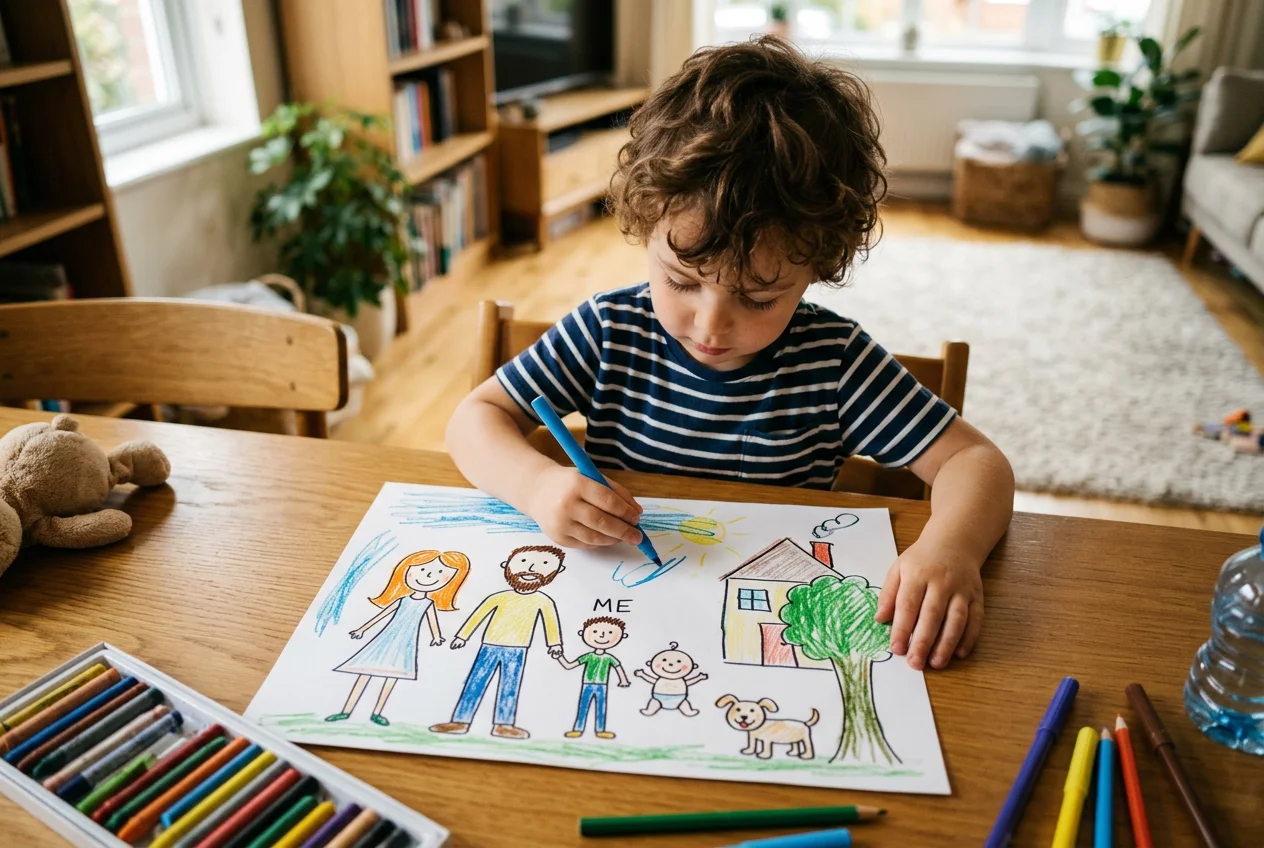
When a child draws a family portrait, they’re making dozens of spatial decisions: the relative sizes of family members, their positioning on the page, the proportions of body parts. Each decision exercises spatial reasoning in a natural, enjoyable way.
Symbol Systems and Literacy
Drawing is one of the first symbol systems children master - before reading and writing. When a three-year-old draws a circle with two dots and a curved line and calls it “mommy,” they’re understanding that marks on paper can represent real things. This is the foundational concept behind all literacy.
Research by education professor Marjorie Siegel and others has shown that children who have rich experiences with visual symbol systems (including drawing) transition more smoothly to written language. The cognitive leap from “this picture represents a cat” to “these letters represent the word cat” is smaller than it appears, and drawing practice makes it even smaller.
Memory and Observation
Drawing from observation - whether it’s a pet, a toy, or a scene outside the window - trains children to look carefully and remember what they see. This isn’t just an art skill. It’s a cognitive skill that transfers to science, reading comprehension, and everyday problem-solving.
A study published in the Quarterly Journal of Experimental Psychology found that drawing something is one of the most effective ways to remember it - more effective than writing about it, looking at a photo, or even repeated viewing. When children draw, they create both visual and motor memories that reinforce each other.
Problem-Solving and Planning
Every drawing involves planning and problem-solving. What should I draw first? How do I fit everything on the page? The tree didn’t turn out right - how can I fix it? I want to draw a bird in flight - how do I show movement?
These are real cognitive challenges that children navigate every time they draw. Unlike structured problem-solving activities (puzzles, worksheets), drawing problems are open-ended. There’s no single right answer, which encourages flexible thinking and creative problem-solving - skills that are increasingly valued in education and the workplace.
The Emotional and Social Benefits
Emotional Expression and Processing
Children often lack the vocabulary to express complex emotions. Drawing provides an alternative outlet. A child who can’t articulate feeling anxious about starting at a new school might draw a picture that reveals those feelings - a tiny figure standing before an enormous building, perhaps.
Art therapists have long recognized drawing as a powerful tool for emotional processing. But you don’t need to be a therapist to benefit from this. Simply providing children with drawing materials and the time and space to use them creates opportunities for emotional expression.
Research from the University of Surrey found that children who engage in regular creative activities show better emotional regulation and lower levels of anxiety. Drawing, specifically, was highlighted as particularly effective because it combines self-expression with the calming effects of repetitive motor activity.
Self-Identity and Confidence
Children’s drawings are deeply personal. The subjects they choose, the colors they use, and the stories they tell through their art all reflect their developing sense of self.
When these drawings are valued - displayed on the fridge, shown to grandparents, talked about with interest - children receive the message that their inner world matters. This validates their identity and builds self-confidence.
Conversely, dismissing or over-correcting children’s drawings can be harmful. Comments like “that doesn’t look like a horse” or “the sky should be blue, not green” teach children that their creative expression needs to meet external standards. This can undermine both confidence and the desire to create.
Communication and Storytelling
Before and even after children learn to write, drawing is a primary storytelling medium. A single drawing often contains an entire narrative that the child is eager to share.
Asking a child to tell you about their drawing (rather than asking “what is it?”) opens rich communication opportunities. Children will often launch into elaborate stories that reveal their understanding of the world, their concerns, their hopes, and their sense of humor.
This narrative drawing strengthens language skills, sequential thinking, and the ability to organize ideas into coherent stories - all of which are crucial for later academic success.
The Physical Benefits
Fine Motor Development
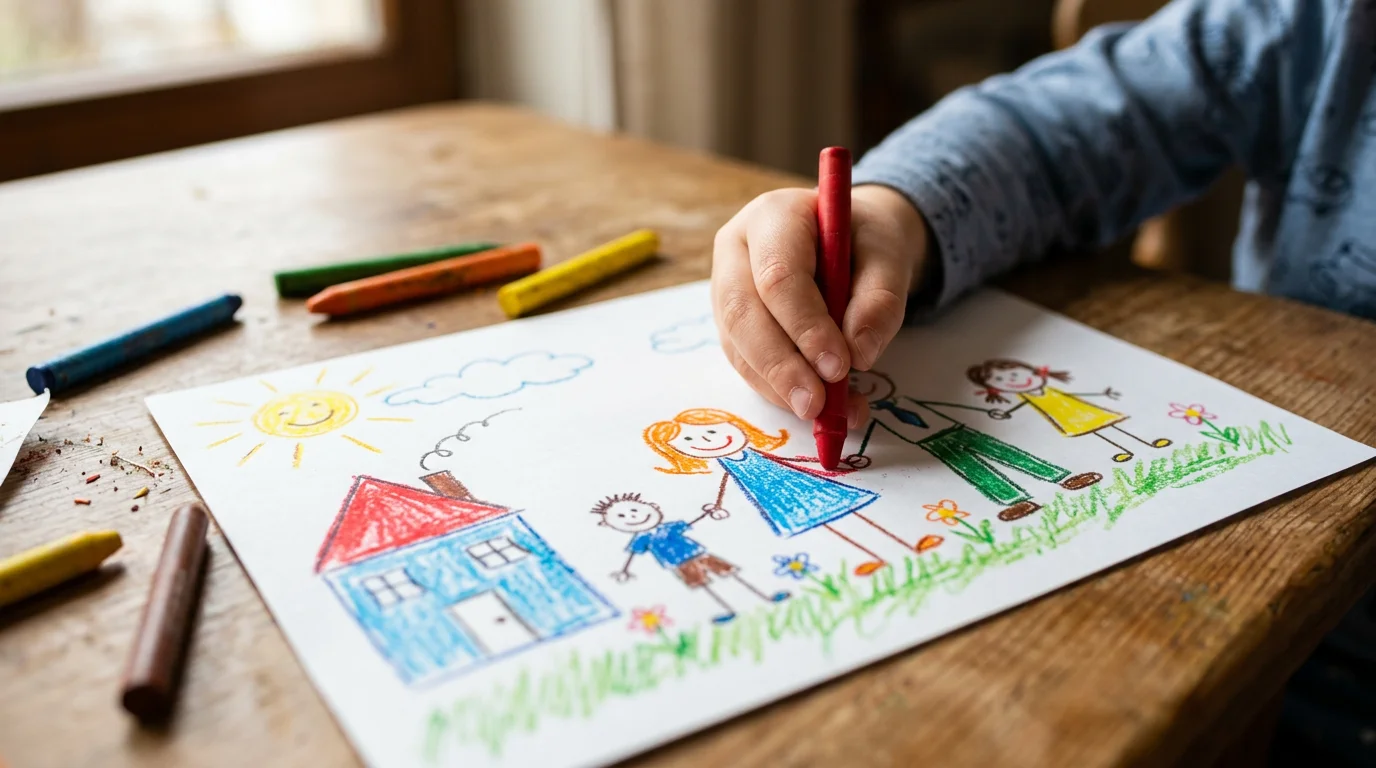
Drawing is one of the best activities for developing fine motor skills - the small, precise movements of the hands and fingers that are essential for writing, typing, using tools, and hundreds of daily tasks.
Holding a crayon, controlling its movement, varying pressure, staying within lines (or intentionally going outside them) - all of these actions strengthen the muscles and neural pathways involved in fine motor control.
Occupational therapists frequently prescribe drawing activities for children with fine motor delays. But all children benefit from regular drawing practice. The more they draw, the more control they develop, and the more sophisticated their drawings (and their handwriting) become.
Hand-Eye Coordination
Drawing requires constant coordination between what the eyes see and what the hands do. The child looks at what they’ve drawn, decides what to add next, and guides their hand accordingly. This feedback loop strengthens hand-eye coordination with every stroke.
This skill transfers to sports, music, crafts, laboratory work, and any activity that requires visual guidance of hand movements. It’s one of the reasons why art education researchers argue that drawing deserves more time in school curricula, not less.
Bilateral Coordination
Many drawing activities require both hands working together - one holding the paper steady while the other draws, or using two colors simultaneously. This bilateral coordination is important for the development of the corpus callosum, the neural bridge between the brain’s hemispheres.
Children who practice bilateral activities like drawing show improvements in activities that require both sides of the body to work together, including handwriting, sports, and musical instrument playing.
Drawing Development Stages
Understanding the normal stages of drawing development helps parents appreciate and encourage their child’s artistic journey.
Scribbling Stage (Ages 1-3)
Children make random marks, gradually gaining more control. By the end of this stage, they begin to name their scribbles, showing the emergence of symbolic thinking. Every scribble is meaningful practice, even when it doesn’t look like anything recognizable.
Pre-Schematic Stage (Ages 3-4)
Children begin drawing recognizable shapes - circles for heads, lines for limbs. The “tadpole person” (a circle with lines extending from it) is a hallmark of this stage. Colors are chosen emotionally rather than realistically.
Schematic Stage (Ages 5-7)
Children develop consistent symbols for common objects - their “schema” for a house, a tree, a person. Baseline and skyline appear. Drawings become more organized and detailed. X-ray drawings (showing both the inside and outside of buildings, for example) are common and normal.
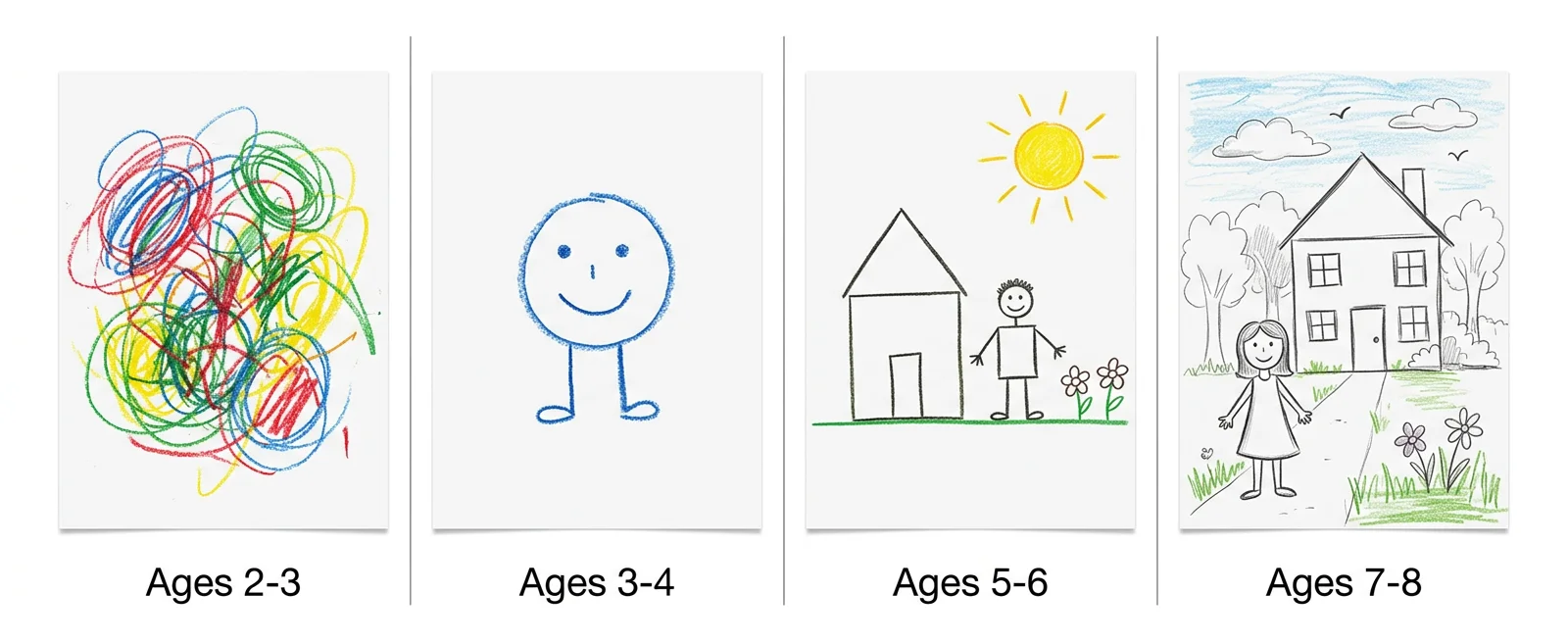
Dawning Realism (Ages 8-10)
Children become more aware of proportions, perspective, and detail. They may become frustrated that their drawings don’t match reality. This is a critical period - encouragement and skill-building are essential to prevent the “I can’t draw” conclusion that leads many children to stop drawing altogether.
The Age of Reason (Ages 10-12)
Some children develop sophisticated drawing skills, while others drift away from visual art. Those who continue drawing through this period typically maintain creative confidence into adolescence and adulthood.
How Parents Can Encourage Drawing
Make Materials Always Available
Keep crayons, markers, colored pencils, and paper accessible. Children draw more when materials are within reach. A dedicated art corner - even a small one - sends the message that creative activity is valued in your home.
Draw Together
Children love seeing their parents draw. It doesn’t matter if you’re “good” at it. Draw alongside your child. Make it a shared activity rather than a solitary one. Your participation validates drawing as a worthwhile activity for people of all ages.
Ask, Don’t Tell
When your child shows you a drawing, ask “Tell me about your drawing” rather than “What is it?” The first invitation opens a door to storytelling and sharing. The second implies the drawing should be identifiable, which can feel like judgment.
Avoid Over-Praising
“That’s the best drawing I’ve ever seen!” might seem encouraging, but it can create performance pressure. Instead, offer specific observations: “I notice you used a lot of blue in this one” or “This character looks like they’re moving really fast.” This shows genuine attention and encourages continued exploration.
Celebrate the Process
Value the act of drawing, not just the product. “You spent a long time on that - you were really focused” is more encouraging than “That’s pretty.” Process-focused praise builds intrinsic motivation and resilience.
Create a Gallery
Display your child’s artwork prominently. Rotate it regularly. This ongoing exhibition communicates that their creative work has real value.
The Drawing Skills Crisis
Despite the well-documented benefits of drawing, children today spend significantly less time drawing than previous generations. Screen time has increased while unstructured creative time has decreased. Many schools have reduced or eliminated dedicated art instruction.
The consequences are real:
- Declining fine motor skills - occupational therapists report increasing numbers of children struggling with handwriting and tool use
- Reduced creative confidence - children who don’t draw regularly are more likely to declare “I can’t draw” at younger ages
- Missed developmental opportunities - the cognitive, emotional, and physical benefits of drawing only accrue through practice
This isn’t an argument against technology. It’s an argument for balance - and for recognizing that drawing deserves a protected place in children’s daily lives.
The Best Drawing Apps for Kids in 2026: Technology as a Creative Amplifier
If drawing is so important, it makes sense to look for tools that encourage more of it rather than less. That’s where the best drawing apps for kids in 2026 come in - not as replacements for crayons and paper, but as creative amplifiers that extend the drawing experience in exciting new directions.
The key is choosing apps that genuinely support children’s drawing development rather than bypassing it. Here’s a research-informed checklist for evaluating any kids’ drawing app:
- Physical drawing stays central - the app should start with the child’s own hand-drawn artwork, not templates, stamps, or AI-generated images
- Celebrates the child’s vision - the output should feel like their creation elevated, not the app’s creation replacing theirs
- Age-appropriate and safe - no ads, no social feeds, no in-app purchases that exploit children’s impulse control
- Motivates more drawing - the best drawing apps create a positive feedback loop where children draw something, see it transformed, and immediately want to draw again
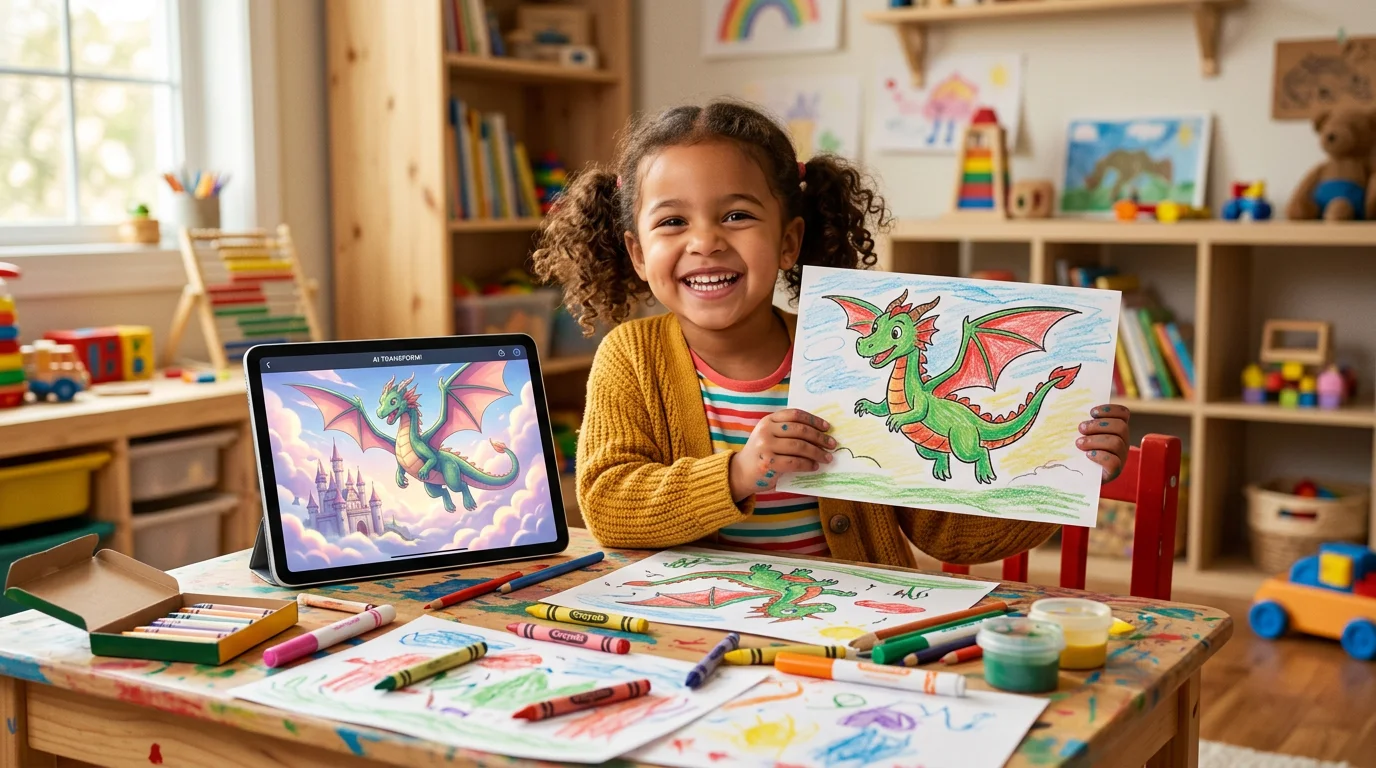
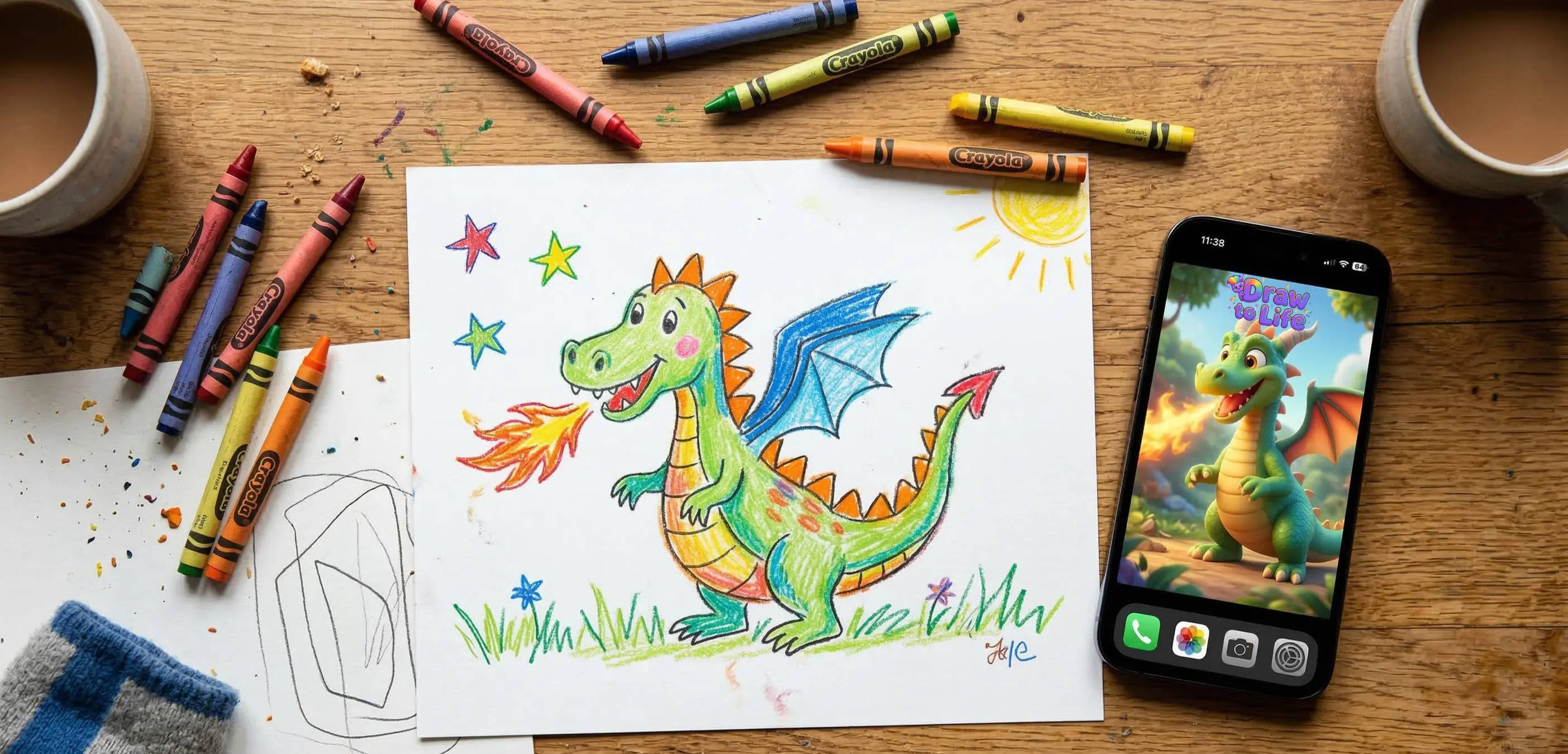
This last point is especially powerful for children’s drawing development. When a child sees their crayon sketch of a dragon reimagined as polished digital art, something remarkable happens: they feel like a “real artist.” That emotional boost drives them back to the drawing table with renewed enthusiasm and ambition. Each drawing-and-transformation cycle reinforces the habit of drawing while building creative confidence.
AI-powered drawing apps take this further by offering multiple artistic styles - a single drawing can become an anime character, a watercolor painting, or a 3D-rendered scene. This variety keeps children engaged and curious, encouraging them to experiment with different subjects and techniques in their physical drawings to see how each one transforms.
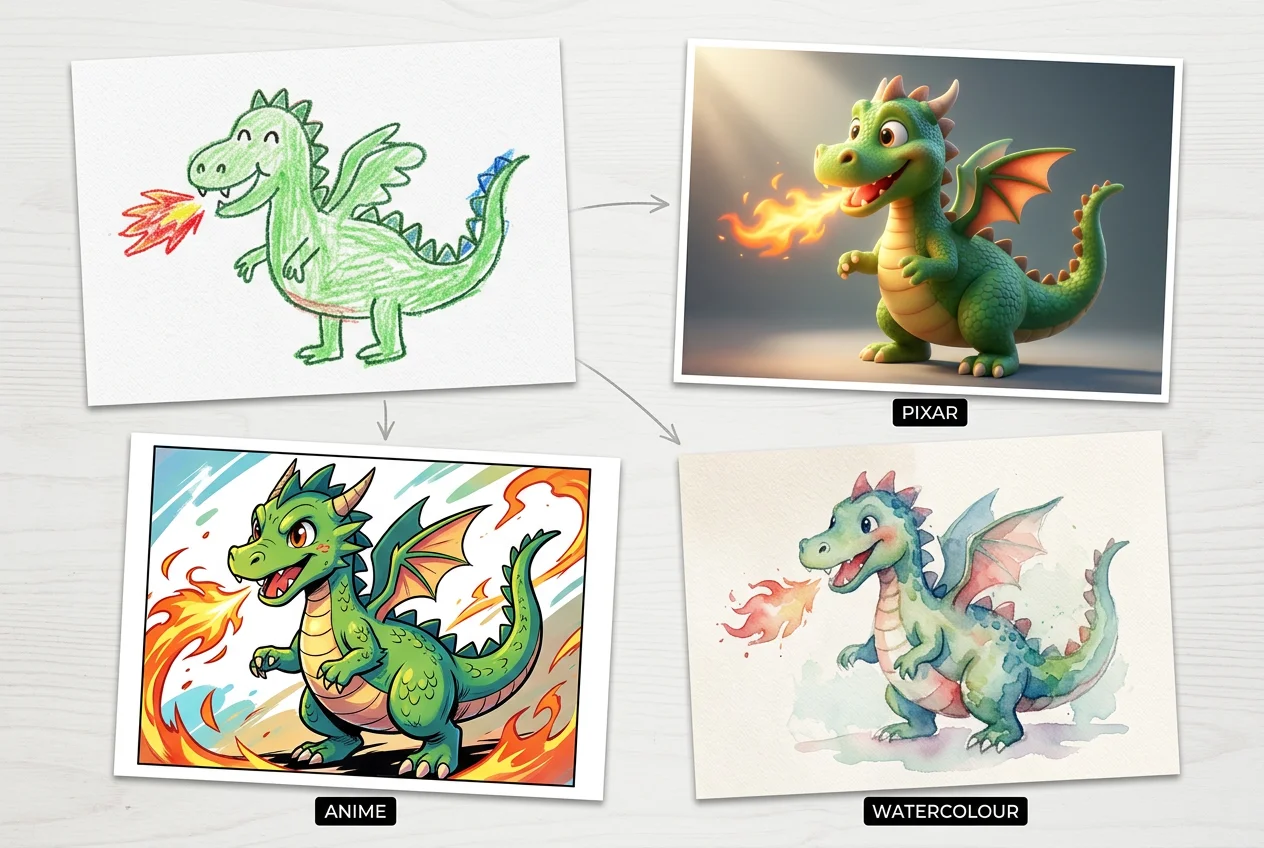
Apps like DrawToLife are designed around these principles, keeping kids drawing skills at the center of the experience while using AI to celebrate and amplify their creativity. The result supports children’s drawing development by making the act of drawing feel magical - because when your crayon sketch becomes a stunning piece of art, you can’t wait to draw the next one. For a deeper look at this creative process, see our guide on turning kids’ drawings into professional art.
Making Drawing Irresistible
The best way to ensure children draw regularly is to make drawing irresistible. Here are some strategies:
- Connect drawing to their interests - a child who loves dinosaurs will happily draw dinosaurs for hours
- Introduce new materials - chalk, pastels, paint sticks, and different paper types keep the experience fresh
- Draw from imagination and observation - alternate between “draw whatever you want” and “let’s draw what we see” sessions
- Use drawing as communication - draw notes to each other, create visual schedules, illustrate stories together
- Transform drawings - use AI tools to show children their artwork in new styles, providing excitement and motivation to create more. Learn more about how AI helps kids express their creativity
The Bottom Line
Drawing isn’t a luxury or a nice-to-have in children’s development. It’s fundamental. It builds the brain, strengthens the body, enriches emotional life, and lays the groundwork for academic success.
Every scribble, every stick figure, every rainbow with too many colors - they all matter. They’re all building something important.
So clear a space at the table, break out the crayons, and let your children draw. Their future selves will thank you.
And when they hand you their latest masterpiece, consider celebrating it in a way that shows them just how extraordinary their imagination really is.